

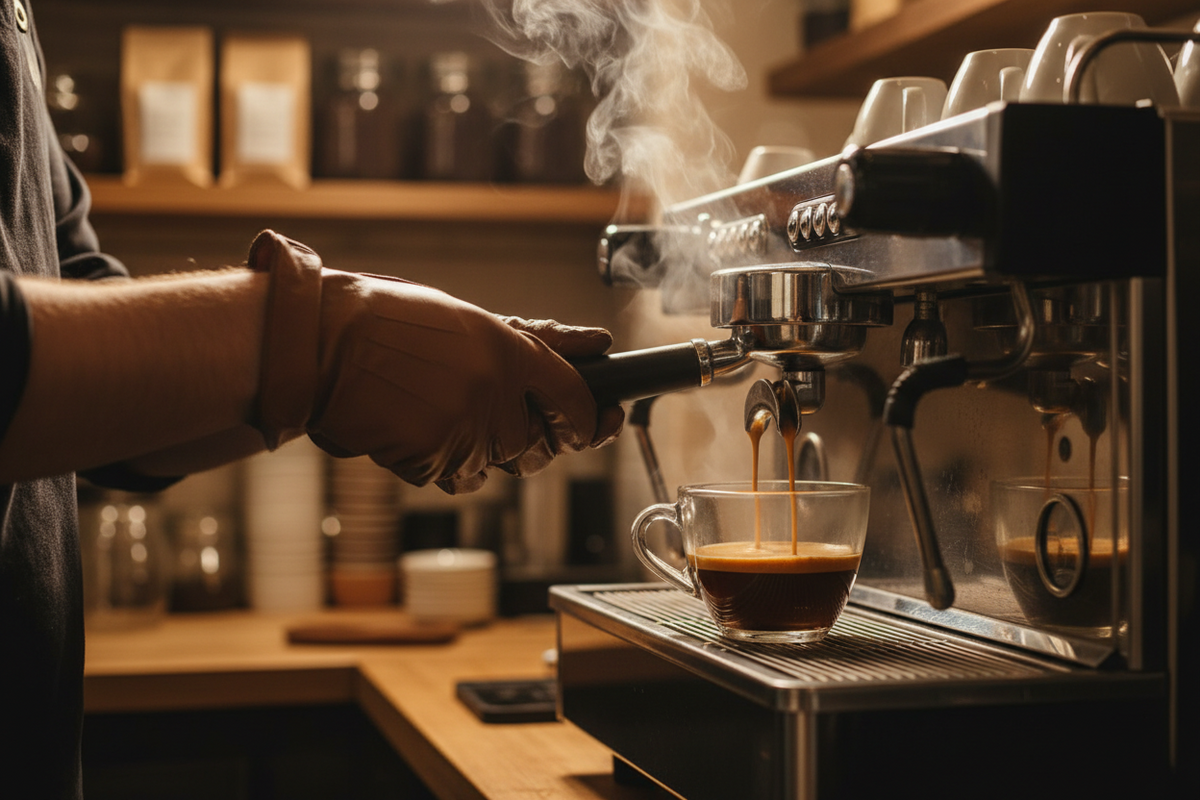
These three brands come up in almost every search for a home espresso machine, and comparing them straight across is a bit like comparing a bicycle, a motorcycle and a car. All three get you coffee. They ask completely different things of you in return.
The useful question is not which brand is best. It is how much work you want to do at 6:40 on a Tuesday morning, and how much you are willing to spend to do less of it.
The three types of machine, plainly
Nespresso makes capsule machines. You drop in a sealed pod, press a button, and a shot comes out in under a minute. There is no grinder, no tamping, no mess. The coffee was ground and dosed in a factory months ago.
De'Longhi is best known for semi-automatic machines with a portafilter, the metal handle you pack with ground coffee and lock into the group head. You control the dose, the tamp and often the grind. The machine supplies pressure and hot water. Everything else is you.
Jura builds superautomatics. Whole beans go in the hopper on top, the machine grinds them fresh for every cup, brews at the right pressure, and dumps the puck into an internal bin. You press one button and clean nothing.
That is the actual decision. Capsule, portafilter, or bean-to-cup.
Nespresso: the one most people should probably buy
Nespresso wins on the metrics that decide whether a machine gets used or shoved into a cupboard. It is small, it is fast, it is nearly impossible to get wrong, and it costs less than a decent pair of winter boots.
The Vertuo Pop+ sits at $109.99 CAD, down from $169.99, and it reads the barcode on each capsule to adjust brewing automatically. The Pixie Titan at $159.99 CAD uses the Original line, which produces a shorter, more traditional espresso with a proper crema. The Vertuo Pop Deluxe runs $189.00 CAD.
Milk is handled separately. The Aeroccino3 frother at $74.99 CAD, reduced from $99.99, heats and foams in about a minute and is genuinely good at it. Adding it to a Vertuo Pop+ still lands you under $200 for a setup that makes a decent flat white.
The honest limitation is that you are locked into pods. You cannot buy beans from a roaster in Vancouver or Halifax and run them through this machine. Capsule prices vary, but budget roughly 70 cents to a dollar per cup depending on whether you buy Nespresso's own or third-party compatibles. Our 50-pod assortment packs bring that number down considerably.
For two coffees a day, that is somewhere around $500 a year in pods. Worth knowing before you decide the machine is the cheap option.
De'Longhi and the semi-automatic middle ground
De'Longhi occupies the space between the other two, and it is the category with the steepest learning curve.
A portafilter machine will make better espresso than a capsule machine if you learn to use it. It will also make considerably worse espresso for the first month while you figure out grind size, dose and timing. Grind too coarse and the shot runs thin and sour in fifteen seconds. Too fine and it chokes to a bitter drip.
You also need a grinder. Pre-ground coffee from a bag does not work well in a portafilter, so budget for a burr grinder on top of the machine unless it has one built in. That is the cost people forget.
Worth being straightforward here: we do not currently stock De'Longhi. If the semi-automatic approach appeals to you, the closest equivalents in our full range of espresso and coffee machines are the Ninja Luxe Cafe 3-in-1 at $799.99 CAD, which includes a built-in grinder and handles espresso, drip and cold brew, and the Ninja Espresso and Coffee Barista System at $349.99 CAD as a lower-cost entry point. The Lavazza LB 300 Classy Mini at $229.99 CAD is a capsule machine rather than a portafilter, but it is a common pick for offices and small kitchens.
Choose this category if the process is part of the appeal. Skip it if you want coffee, not a hobby.
Jura: paying to skip the work entirely
Jura is Swiss, expensive, and very good at exactly one thing: producing consistently decent espresso with zero effort.
Our current Jura automatic espresso machines start at $2,095.00 CAD for the Piano White model and run to $2,750.00 CAD, with the fourth-generation Piano Black at $2,695.00 CAD.
What that money buys is a conical burr grinder, an automatic brewing unit that adjusts extraction, integrated milk systems on most models, and automated rinsing and cleaning cycles. You fill the bean hopper and the water tank. The machine does the rest, including telling you when it needs descaling.
Fresh beans matter more than most people expect. Coffee starts losing aromatics within days of grinding, which is why a superautomatic grinding per cup will often beat a capsule on flavour despite the capsule's sealed packaging.
The value case depends on volume. At $2,095 with beans at roughly 25 to 35 cents per cup, a household drinking four coffees a day passes a Nespresso setup on total cost somewhere around year four or five. Two coffees a day and it never quite catches up.
Buy a Jura because you want café-quality coffee on demand without touching anything, and because you will use it several times daily. Buying one to make one americano each morning is an expensive way to save thirty seconds.
The things that actually decide it
Counter space. Superautomatics are large and need clearance above for the bean hopper lid. Measure before ordering.
Water. Much of Ontario and the Prairies has hard water, which scales up boilers fast. Every machine here needs descaling, but the more expensive the machine, the more it matters. Use filtered water and follow the schedule.
Milk drinks. If you mostly drink lattes and cappuccinos, milk texture matters more than shot quality. A $110 Nespresso paired with a $75 frother will make a better cappuccino than a $400 machine with a bad steam wand.
Household size. One drinker leans capsule. Four drinkers with different preferences leans superautomatic, because nobody is grinding and tamping four times each morning.
The short answer
Under $300 and want it simple, buy a Nespresso and an Aeroccino. Somewhere in the middle and willing to learn, look at the Ninja machines with built-in grinders. Drinking several coffees a day for years to come and tired of the process, a Jura pays for itself in convenience long before it does in dollars.
Share:
Best Cordless Drill Combo Kits in Canada (2026)